
Search This Blog

Showing posts with label Carbohydrate. Show all posts

The Importance of Eating a Balanced Diet - Carbohydrates, Fats and Proteins

zz
Do you know where your calories come from? For most normal people, their calories are supplied by carbohydrates, fats and proteins. The only difference is the ratio each type of food contributes to these calories. Unlike popular perception, any excess calories you do not use up gets converted to body fat. So, even if you eat a completely fat-free all-fruit diet, you can still get fat if you do not get enough exercise. On the other hand, if you are on some extreme form of Atkins diet with high protein and high fat, do add some carbohydrates to your diet. Without this carbohydrate, you will likely feel listless and enervated, because fat needs a bit of carbohydrate to be properly consumed.

Even if you expect to get most of your energy from protein, as long as there is fat in your diet, make sure you include a little bit of carbohydrates as well. If you fail to do this, acid products will accumulate from the incomplete conversion of fat. This will eventually lead to untoward results. Fortunately, it does not mean that you have to eat rice, or bread, or french fries together with your steak. Fruits can provide the carbohydrates you need. Or even a small, sweet dessert can do the trick. Of course, when you add that dessert to your meal, please remember to cut down on your steak. The key to losing weight is to eat less calories than you burn everyday.

Now, what if you are on an extreme vegan no-fat diet? Unless your doctor recommended this diet to address a particular health problem, I would advise you to add some fat to your diet. Animal experiments conducted by scientists have shown that fat-free diets produce kidney diseases and an alarming disinterest in the opposite sex. In other words, fats are essential to normal nutrition.

In general, there is no excuse to completely eliminate protein from your diet. Even on a vegan diet, there are certain nuts and beans you should add to your diet to ensure that you have an adequate supply of protein. You may ask, "Why do I need protein in my diet?" There are three reasons. Firstly, together with carbohydrates and fats, proteins also provides the energy you need for your daily living.

Secondly, protein is the building block of your body. After exercise, and even in your normal day-to-day life, your muscle tissue will die out. Not just the muscles in your arms and legs, but the muscles in your internal organs. You need protein to rebuild these muscles. The third and most important reason is that proteins provide the amino acids needed to create the hormones and neurotransmitters in your body and mind. Basically, an imbalanced diet with too much or too little protein could lead to problems like acne, impotence, infertility, slowness of thought, timidity or over-aggression.

Overall, if you are reducing weight with a DIY diet plan, you should make sure you have a balanced diet. Your calories need to come from carbohydrates, fats and proteins. Just remember to eat a bit less and exercise a bit more and you will definitely lose weight.


Article Source: http://EzineArticles.com/?expert=Calvin_Loh

BodyBuilder's Guide To Carbohydrates - Sources And Timing

zz
Carbohydrates (Carbs) are an essential part of the bodybuilders diet, and are your bodies preferred source of energy. Your body stores carbs as glycogen in the liver and muscle tissues.When your body needs energy, it begins the process of Glycolisis, which is the process of converting carbs and sugar to energy. When your body is lacking carbs, it can and will use protein and muscle tissue as an energy source. This is known as the catabolic state, when your body breaks down its own muscle for energy. Only through a properly planned and executed diet, a bodybuilder can obtain sufficient carbohydrate intake to reach its fullest muscle building potential.

In order to build muscle and not gain fat, it is crucial for a bodybuilder to understand the different types of carbohydrates available, and the proper timing for each source. This article will cover these topics, as well as the nutritional value of carbohydrate sources ideal for muscle building.

Types of Carbohydrates: There are 3 main types of carbohydrates a BodyBuilder, and HardGainer especially, should be concerned with. Simple carbs, Complex carbs, and Dietary Fiber.

Simple Carbs (Sugars)-Provide immediate energy by entering the blood stream quickly, and creating an insulin spike in the body. If Simple Carbs are not quickly used as energy, they will be stored as fat. Fruits, juices, and basically anything with sugar are examples of Simple Carbs.
Complex Carbs (Starches)-Actually contain more sugar than Simple Carbs, but provide a slower release in the blood stream. Therefore, your body has a longer time to utilize this source before it is stored as fat. Potatoes, rice, oats, and pasta are examples of Complex Carbs.
Dietary Fiber-Plays an extremely important role in the body by assisting in the removal of waste. Fiber is crucial in a bodybuilder's diet as a high protein, high calorie diet will cause constipation in many. Beans, corn, and broccoli are examples of dietary fiber.


Timing: Due to the quick response of Simple Carbs, they are ideal in situations when your body is in dire need of replenishing its glycogen stores. This occurs in the morning upon waking, and immediately after your workout. In the morning consider eating fruit, and post-workout consider a dextrose powder. Due to the slower, extended release of Complex Carbs, they are ideal pre-workout, when you need fuel for a workout, and throughout the day when you need a constant source of nutrients to fuel the muscle building process. Fiber sources should be consumed earlier on in the day to be able to work effectively throughout the day to aid in the waste removal process. Bodybuilders should attempt to stop eating carbohydrates approximately 2 hours before bed. When you are not active, such as when you sleep, your body will not need to use the carbohydrates for energy, and will tend to store them as fat.
Article Source - http://www.hardgainersguide.com/hardgainers-guide-to-carbohydrates-sources-timing-and-nutritional-value/

Visit HardGainer's Guide for more articles like this! - http://www.hardgainersguide.com

Article Source: http://EzineArticles.com/?expert=Jason_Khehra

Do Potatoes Make You Fat?

zz

Do Potatoes Make You Fat?
By Josh Stone

Many people have the misconception that we need to eliminate all high carbohydrate foods, including pasta, rice and potatoes. If you haven't noticed by now, potatoes are always under fire by most people, which I believe is because they are a component of most fast-food meals, thus tarnishing the 'image' of the healthy potato.

However, if you think about it - carbohydrates are the body's preferred energy source, and eating a potato (or any other type of carb rich food) will not automatically make you fatter. Substituting a serving of rice with a baked potato is an excellent way of adding variety to your diet. Consuming too many potatoes, however, is of course unecessarily piling up the calories (and this is a problem with any food, not just potatoes!).

Just like everything else, you should enjoy your potates in moderation. Watch the intake of your other cards in the same meal if you're having a little extra potatoes for the meal. Overdo it, and you're back to square one again.

If you're watching your weight, you might just want to enjoy potatoes in moderate quantities and not make the common mistake of 'abusing' your poor potato before you eat it (adding butter, sour cream, or frying it!).

Enjoy your potatoes! I know I do. ;)

Josh Stone, also known as DM, is the author behind the site http://www.dailymuscle.com which offers the author's personal views on real-life fitness, bodybuilding, sports nutrition, cardio, fat loss, training information, and on all things that surrounds fitness.

Article Source: http://EzineArticles.com/?expert=Josh_Stone

The Diabetic Diet

zz


Diet is very important in diabetes. Below is a guideline with some general principles taken from endocrineweb.


Patients with Type 1 diabetes should have a diet that has approximately 35 calories per kg of body weight per day (or 16 calories per pound of body weight per day).

Patients with Type 2 diabetes generally are put on a 1500-1800 calorie diet per day to promote weight loss and then the maintenance of ideal body weight.

However, this may vary depending on the person's age, sex, activity level, current weight and body style. More obese individuals may need more calories initially until their weight is less. This is because it takes more calories to maintain a larger body and a 1600 calorie diet for them may promote weight loss that is too fast to be healthy. Men have more muscle mass in general and therefore may require more calories. Muscle burns more calories per hour than fat. (Thus also one reason to regularly exercise and build up muscle!) Also, people whose activity level is low will have less daily caloric needs.

Generally, carbohydrates should make up about 50 percent of the daily calories ( with the accepted range 40-60 percent). In general, lower carbohydrate intake is associated with lower sugar levels in the blood. However the benefits of this can be cancelled out by the problems associated with a higher fat diet taken in to compensate for the lower amount of carbohydrates.. This problem can be improved by substituting monounsaturated and polyunsaturated fats for saturated fats.

Most people with diabetes find that it is quite helpful to sit down with a dietician or nutritionist for a consult about what is the best diet for them and how many daily calories they need. It is quite important for diabetics to understand the principles of carbohydrate counting and how to help control blood sugar levels through proper diet. Below are some general principles about the diabetic diet.

1. Why count carbohydrates?

Carbohydrate makes your blood glucose level go up. If you know how much carbohydrate you've eaten, you have a good idea what your blood glucose level is going to do. The more carbohydrates you eat, the higher your blood sugar will go up.

2. Which foods contain carbohydrate?

Most of the carbohydrate we eat comes from three food groups: starch, fruit and milk. Vegetables also contain some carbohydrates, but foods in the meat and fat groups contain very little carbohydrate. Sugars may be added or may be naturally present (such as in fruits). The nutrient term for sugars can also be identified by looking for -ose at the end of a word ( i.e. glucose, fructose, sucrose, etc. are all sugars). Look for these on food labels to help identify foods that contain sugar.

Below are some examples of carbohydrate grams for some common food items:


To make things easy, many people begin carbohydrate counting by rounding the carbohydrate value of milk up to 15. In other words, one serving of starch, fruit or milk all contain 15 grams carbohydrate or one carbohydrate serving. Three servings of vegetable also contain 15 grams. Each meal and snack will contain a specific total number of grams of carbohydrate.

For example: Each gram of carbohydrate provides 4 calories. A diabetic on a 1600 calorie diet should get 50% of these calories from carbohydrate. This would be a total of 800 calories or 200 gms of carbohydrate (at 4 calories per gram) spread out over the day. At 15 grams per exchange, this would be about 13 exchanges of carbohydrate per day.

The amount of food you eat is closely related to blood sugar control. If you eat more food than is recommended on your meal plan, your blood sugar goes up. Although foods containing carbohydrate (carb) have the most impact on blood sugars, the calories from all foods will affect blood sugar. The only way you can tell if you are eating the right amount is to measure your foods carefully. Also, it is important to space your carbohydrates out throughout the day to avoid sugar "loading." Measuring your blood sugar regularly also provides important feedback on how high your sugar went based on what you ate and your level of activity.

Where do you get carbohydrate information?

The "Nutrition Facts" label on most foods is the best way to get carbohydrate information, but not all foods have labels. Your local bookstore and library have books that list the carbohydrate in restaurant foods, fast foods, convenience foods and fresh foods. You will still need to weigh or measure the foods to know the amount of grams of carbohydrates present.

How do you count carbohydrate?

Carbohydrates can be counted in number of grams or can be counted as exchanges. One carbohydrate exchange equals 15 grams of carbohydrate. A good reference for learning how to count calories in this manner will be on line here

soon including a calorie computer.

Free Foods:

These are foods that you can eat without counting. A free food or drink is one that contains less than 20 calories and 5 grams or less of carbohydrate per serving. If your serving or a food contains more than 5 grams of carbohydrate, you should count it in your meal plan.

Examples of free foods:

Bouillon or broth
Carbonated or mineral water
Club soda
Coffee or tea
Diet soft drinks
Drink mixes, sugar-free
Tonic water, sugar free
Sugar-free hard candy
Sugar-free Jell-O
Sugar-free gum
Jam or jelly, light or low-sugar, 2 tsp.
Sugar free syrup, 2 tsp.

You should spread out free foods throughout the day and not eat them in one sitting.


Fitting Sugar in Your Meal Plan

It is commonly thought that people with diabetes should avoid all forms of sugar. Most people with diabetes can eat foods containing sugar as long as the total amount of carbohydrate (carb) for that meal or snack is consistent. Many research studies have shown that meals which contain sugar do not make the blood sugar rise higher than meals of equal carbohydrate levels which do not contain sugar. However, if the sugar-containing meal contains more carb, the blood sugar levels will go up.

Does this mean I can eat cake and not worry about it?

No! A slice of white cake with chocolate icing ( 1/12 of a cake or 80 gram weight) will give you about 300 calories, 45 grams of carb and 12 grams of fat. That is three starch servings and over 2 fat servings. Before you have a slice of cake, ask yourself the following questions: Will that small piece of cake be satisfying or will I still be hungry? How it will fit into my meal plan? Do I have 300 calories to "spend" on this? Are there other choices I could make which would contribute less fat? A 1/12 slice of angel food cake has less than 1 gram of fat and only 30 carb. This may be a better choice.

Controlling all carbohydrates

It is important to realize that sugar is not the only carbohydrate that you have to "control". The body will convert all carbohydrates to glucose - so eating extra servings of rice, pasta, bread, fruit or other carbohydrate foods will make the blood sugar rise. Just because something doesn't have sugar in it doesn't mean you can eat as much as you want. Your meal plan is designed so that the carbohydrate content of your meals remains as consistent as possible from day to day.

A word of caution:

Although sugar does not cause the blood sugar to rise any higher than other carbohydrates, it should be eaten along with other healthy foods. If you choose to drink a 12 ounce can of a sugar-sweetened soft drink, that would use up about 45 grams carb - and you wouldn't have gotten any nutrition (protein, vitamins or minerals). What a waste of calories! High sugar foods are more concentrated in carb. Therefore the volume would be smaller than a low sugar food. High sugar foods might not be a good choice if they will just tempt you to eat more. If you would rather eat larger portions, select low sugar choices. Look at the differences in portion size you get for equal amounts of carbohydrate in these cereals!


In addition, many sugar-containing foods also contain a lot of fat. Foods such as cookies, pastries, ice cream and cakes should be avoided largely because of the fat content and because they don't contribute much nutritional value. If you do want a "sweet" - make a low-fat choice, such as low-fat frozen yogurt, gingersnaps, fig bars or graham crackers and substitute it for another carbohydrates on your meal plan.

Carbohydrate

zz
Definition

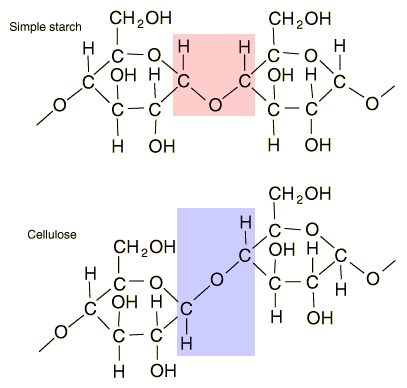
Carbohydrates are one of the three main nutrients in food. Alternative names for carbohydrate are Starches; Simple sugars; Sugars; Complex carbohydrates; Diet - carbohydrates; Simple carbohydrates. Carbohydrates (carbs) are the body's major source of energy. There are two main types of carbohydrates - sugars and starches.

The body breaks down carbs into the sugar glucose, which the body's cells need. Glucose is absorbed into the bloodstream, which makes the sugar level in the blood go up. As the sugar level rises in the body, the pancreas releases a hormone called insulin. Insulin is needed to move glucose from the blood into the cells, where it can be used as a source of energy.


Food Sources

Carbohydrates are classified as simple or complex. The classification depends on the chemical structure of the particular food source and reflects how quickly the sugar is digested and absorbed. Simple carbohydrates have one (single) or two (double) sugars while complex carbohydrates have three or more.


Examples of single sugars from foods include fructose (found in fruits) and galactose (found in milk products). Double sugars include lactose (found in dairy), maltose (found in certain vegetables and in beer), and sucrose (table sugar). Honey is also a double sugar, but unlike table sugar, contains a small amount of vitamins and minerals.


Complex carbohydrates, often referred to as "starchy" foods, include:

  • Whole grain breads and cereals
  • Starchy vegetables
  • Legumes


Simple carbohydrates that contain vitamins and minerals occur naturally in:


Simple carbohydrates are also found in processed and refined sugars such as:

  • Candy
  • Table sugar
  • Syrups (not including natural syrups such as maple)
  • Regular (non-diet) carbonated beverages, such as soda


Refined sugars provide calories, but lack vitamins, minerals, and fiber. Such simple sugars are often called "empty calories" and can lead to weight gain. Also, many refined foods, such as white flour, sugar, and polished rice, lack B vitamins and other important nutrients unless they are marked "enriched." It is healthiest to obtain carbohydrates, vitamins, and other nutrients in as natural a form as possible -- for example, from fruit instead of table sugar.


Side Effects


Excessive carbohydrates can cause an increase in the total caloric intake, causing obesity.


Deficient carbohydrates can cause a lack of calories (malnutrition), or excessive intake of fats to make up the calories.


Recommendations


For most people, between 40% and 60% of total calories should come from carbohydrates, preferably from complex carbohydrates (starches) and naturally occurring sugars. Complex carbohydrates provide calories, vitamins, minerals, and fiber.

Foods that are high in processed, refined simple sugars provide calories, but they have few nutritional benefits. It is wise to limit such sugars.

To increase complex carbohydrates and healthy nutrients:

  • Eat more fruits and vegetables.
  • Eat more whole grains, rice, breads, and cereals.
  • Eat more legumes (beans, lentils, and dried peas).

Here are recommended serving sizes for foods high in carbohydrates:

  • Vegetables: 1 cup of raw vegetables, or 1/2 cup cooked vegetables, or 3/4 cup of vegetable juice
  • Fruits: 1 medium size fruit (such as 1 medium apple or 1 medium orange), 1/2 cup of a canned or chopped fruit, or 3/4 cup of fruit juice
  • Breads and cereals: 1 slice of bread; 1 ounce or 2/3 cup of ready-to-eat cereal; 1/2 cup of cooked rice, pasta, or cereal; 1/2 cup of cooked dry beans, lentils, or dried peas
  • Dairy: 1 cup of skim or lowfat milk

Here is a sample 2,000 Calorie menu of which 50-60% of the total calories are from carbohydrates.

  • Breakfast
  1. 1 cup of raspberries
  2. 1 1/2 cups of unsweetened cereal, with 1/2 sliced banana
  3. 1 cup of skim milk
  4. 1 slice of whole wheat toast
  5. 1 teaspoon of margarine
  6. 1 teaspoon of jelly
  7. Coffee or tea

  • Lunch
  1. turkey pita pocket sandwich (2 slices of whole wheat pita bread, 3 ounces of lean turkey breast )
  2. 1/2 cup of shredded lettuce
  3. 1/2 cup of diced tomatoes
  4. 1/2 cup of green peppers
  5. 1 tablespoon of salad dressing
  6. 1 cup of skim milk
  7. 2 fresh, medium-sized peaches
  • Dinner
  1. 4 ounces of broiled salmon with 3 tablespoons of lemon juice, sprinkled with paprika
  2. 1 cup of pasta
  3. 1 dinner roll
  4. 1 steamed broccoli stalks with black pepper
  5. salad:
    1 cup lettuce
    1/4 cup of sliced mushrooms
    1/2 cup of sliced tomatoes
    1/2 cup of sliced carrots
    1 tablespoon of salad dressing
    1/2 cup frozen unsweetened strawberries, sweetened with 1 teaspoon of sugar
    1-inch slice of angel food cake
    1 cup of skim milk